
App development in Dallas–Fort Worth, starting with whether you need one.
Native iPhone and Android apps, progressive web apps, and custom platforms — designed and built by the same small team you talk to on the first call.
We’re based in Denton, Texas, and we work across the Dallas–Fort Worth Metroplex. Apps and platforms are quoted per project, and most start around $15,000.
Most businesses that want an app need a progressive web app.
That sentence costs us money and we keep saying it. An app is the most expensive thing a small business can decide it needs, and most people who ask for one are describing a progressive web app.
What a native app is actually for
A native app is installed from the App Store or Google Play and written twice — once for iPhone, once for Android. That expense buys the parts of a phone the web can’t reach cleanly: background location, deep camera and sensor work, real offline use, heavy on-device processing, in-app purchases. If your product is the thing somebody opens every day, native is right and we’ll build it. What matters is that the reason is on that list, and not “our competitor has one.”
What a progressive web app is for
A progressive web app is a website built to behave like an app: it installs to the home screen with its own icon, opens full screen with no browser bar, works offline, and can send notifications, but it lives at a web address. One codebase instead of two, no review queue between a bug and its fix, and nothing to download before somebody can try it. An app store is four or five steps between hearing about you and using you. A link just opens.
Radius, the platform we built for Valley Creek Church, is a progressive web app for exactly that reason — staff open it on a phone in a lobby and a laptop at a desk, from one build.
What each one costs, in money and in time
Native means two builds and two of everything afterwards: two release processes, two sets of device bugs, two updates every time you change a price. A web app is one build that runs on both phones and every desktop you already have. It’s also the shorter road, and it can go live in pieces — where native has a review queue at Apple and another at Google standing in front of every release and every fix. Annual developer fees sit on top: small next to the build, unwelcome if nobody warned you.
How to tell which one you need
- Go native if the phone itself is the point. Background location, sensors, real offline use, in-app purchases.
- Go native if people will open it most days. A home-screen icon earns its cost through habit, and a web app can sit there anyway.
- Go web if it will change often. A web app ships a Friday fix in minutes. A native one joins a queue, twice.
- Go web if it’s for your own staff. Nobody wants a company app on their personal phone, and internal tools change constantly.
- And sometimes you need neither. Plenty of app conversations end with a website that finally does its job. Seven signs your site is the real problem →
We’d rather talk you out of a $15,000 app than sell you one. Being wrong here costs you a year and a budget, and you find out at the end. So we have the argument at the start, for free.
Software, not a brochure with a login on it.
Six things, and most projects are two or three of them at once.
iPhone & Android apps
From the first sketch to the app stores — the listings, the screenshots, the disclosures, and the reviewer who wants one more change.
Progressive web apps
One build that installs to a home screen, works offline, and runs everywhere. Usually the right answer, and usually the cheaper one.
Custom internal tools
A gap held together with spreadsheets, exports, and somebody’s memory is a product waiting to be built.
Integrations
New software that reads the system you already pay for, rather than asking your team to type everything twice.
Product design & brand
The name, the mark, the screens. Software that feels made rather than assembled gets opened without being asked. Why the mark isn’t the brand →
Ongoing development
Launch is where the real list of changes comes from. We stay on what we build, so you send a message rather than hire an engineer.
Three we can point at.
A platform for a church, an app of our own, and a decade of design work on somebody else’s platform.
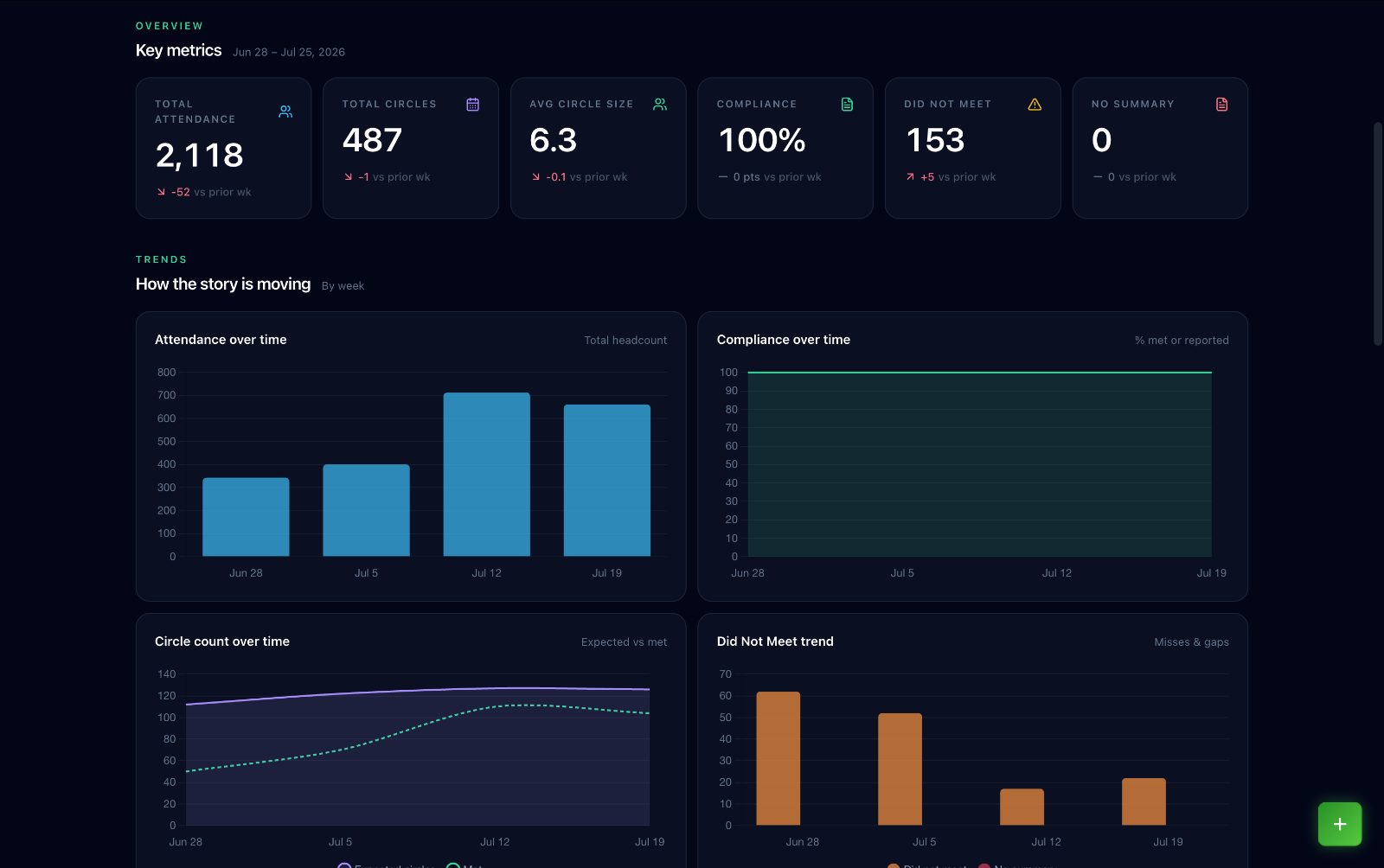
Radius
A custom internal platform for Valley Creek Church — named, branded, product-designed, and built in-house as a Next.js progressive web app on Supabase, running on their existing Church Community Builder data. Role-based access, real-time reporting, a kanban board where the cards are people, leader relationship history, onboarding, bulk texting over iMessage, and AI that reads the week’s small-group summaries.
Read the case study →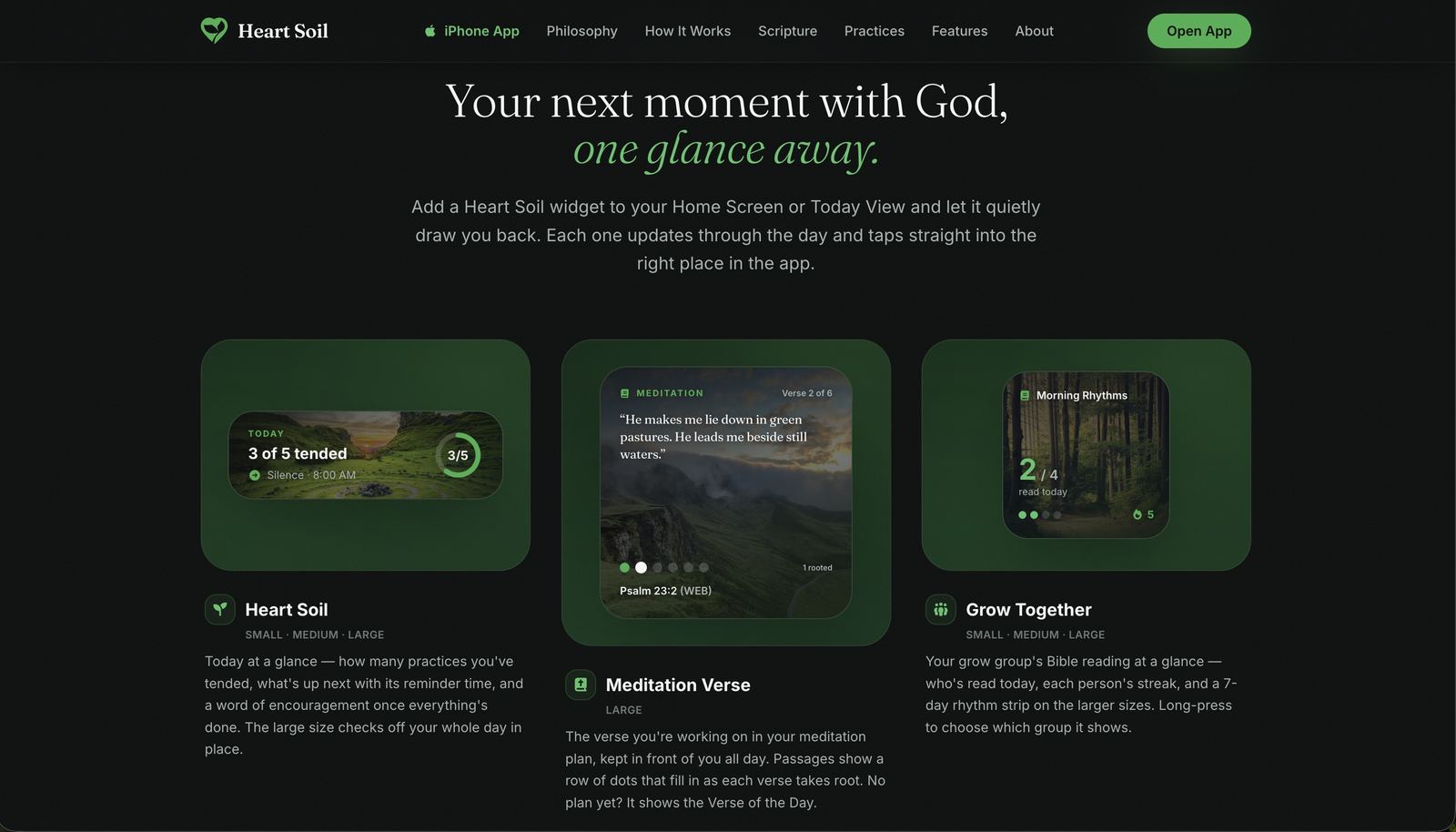
My Heart Soil
An idea with no name, no identity, no site, and no app — taken to launch entirely in-house. The brand, the marketing site, and an app that ships on iPhone and as a web app that works offline, with prayer topics, Scripture, a journal, and home-screen widgets.
Read the case study →
Switch Commerce
A Texas payments company whose own engineers write their terminal management platform, on the web and on a phone. We don’t write it. We work on the part that decides whether all that engineering feels like a tool or a chore.
Read the case study →Three steps. One team.
Tell us what it has to do
Not what platform you want — what job the software does, who opens it, and what they’re doing when they do. That conversation settles the native-or-web question, and it costs nothing.
Scope, design, build
A written scope with a number in it before anything gets made. Then product design — screens, flows, the name and the mark if it needs them — then the build, with something to look at as it goes.
Launch, then keep going
Through the app stores, or onto your own domain. Then we stay on it: software isn’t finished at launch, that’s when it starts being used.
Quoted per project, and most start around $15,000.
Apps and platforms don’t take a flat price honestly, so we don’t publish one. Most start around $15,000. A progressive web app usually lands nearer the bottom of a quote than a pair of native builds; a platform with integrations, roles, and reporting behind it costs more than either.
Half up front, half at launch, and nothing starts without a written scope, so nobody is arguing six weeks later about what was included. Hosting, domains, and developer accounts are set up in your own name and billed to you directly. Nothing resold, nothing marked up.
And if the honest answer turns out to be a website rather than an app, the numbers on that side are public too. What a website actually costs in Dallas–Fort Worth →
App developers in the DFW Metroplex.
We’re based in Denton and we build for businesses across Dallas–Fort Worth — Lewisville, Flower Mound, Southlake, Grapevine, Plano, Frisco, McKinney, Allen, Dallas, Fort Worth, Arlington, and Irving. When a project is easier to sort out in a room, we’ll come sit in one — and when it isn’t, Zoom or a phone call does the job just as well. However you’d rather talk to us, we’re here.
Behind the studio is more than twenty years in marketing and, between Trip Ochenski and Vic Gardner, more than forty years of making things for clients. New Journey Designs is a woman-owned business, and Erin Ochenski and Kimberly Gardner keep the studio moving forward as Chief Administrative Officer and Chief Financial Officer. It’s a small team on purpose: whoever scopes your app is who builds it.
If the honest answer turns out to be a website rather than an app, that’s the same team. Web design in Dallas–Fort Worth →
Email info@newjourneydesigns.com and tell us what you’re trying to build. We reply within one business day.
Questions people actually ask.
What does an app cost in Dallas–Fort Worth?
Apps and platforms are quoted per project, and most start around $15,000. A platform with integrations, roles, and reporting behind it costs more. You get the number in writing before anything is built. Anyone quoting an app price before asking what the app does is quoting a guess.
Do I need a native app or a progressive web app?
Most businesses that ask us for an app need a progressive web app. Native earns its cost when you need the phone itself — background location, sensors, real offline use, in-app purchases — or when people will open it most days. Anything used occasionally, or built for your own staff, usually belongs on the web.
How long does an app take to build?
Longer than a website, and we won’t pretend otherwise. A web app is the shorter road: one build, and it can go live in pieces. Native is longer — two builds, then a review queue at each store before anyone downloads anything. The honest answer for your project comes with the written scope.
Do you submit the app to the App Store and Google Play for us?
Yes. The builds, the listings, the screenshots, the privacy disclosures, the submission, and the resubmission when a reviewer wants something changed. Developer accounts are set up in your name and billed to you directly, so the app is your business’s in the store, not ours.
Who owns the code?
You do, on final payment. Source, design files, accounts, the lot — yours outright, with nothing held back to keep you on a retainer. Before final payment it isn’t, which has never once come up but is the honest answer.
Can you integrate with the software we already run?
Usually, if it has an API. Radius runs on Valley Creek Church’s existing Church Community Builder data — the people, the circles, the meetings, the attendance — and nobody re-keys anything. The fastest way to kill a new tool is to make it a second place to type things already typed somewhere else.
What happens after launch?
Software gets used, and used software needs changing. We keep building on what we ship, and Support Plans sit underneath it: $49 a month for Basecamp, $149 for Ascent and ongoing changes, $299 for Summit and a standing block of design and development time. Every account stays in your name, so leaving means removing our access rather than migrating anything.
Do you only work with businesses in the DFW Metroplex?
No. We’re in Denton and a lot of our clients are around the Metroplex, so we can sit in a room with you when that helps. But everything from first conversation to launch works over video calls, email, and a shared project page, and we work with clients across the country.
Tell us what the thing has to do.
Not the platform, not the feature list — the job. We’ll tell you whether it’s a native app, a progressive web app, or something smaller than both, and that conversation costs nothing either way.
Start Your Journey